Non-Sewered Sanitation and Decentralised Treatment
Flagship research on sanitation systems that safely contain, treat and manage human waste without conventional sewer networks.
Know moreSix research themes addressing the implementation gaps that determine whether sanitation actually works — for everyone, every day.
In 2024, 3.4 billion people still lacked safely managed sanitation. Only 56% of domestic wastewater was safely treated. Across low- and middle-income countries, the majority of urban areas are not connected to sewer networks — meaning that household toilets, community facilities, schools and public conveniences must contain, treat and manage waste on site or through decentralised systems.
Non-sewered sanitation is not a temporary solution waiting to be replaced by sewers. For most of the world's urban population, it is the permanent infrastructure of daily life. The question is not whether non-sewered systems will be used — it is whether they will be designed, operated and maintained well enough to deliver safely managed sanitation.
SDG 6 does not ask whether a toilet was built. It asks whether excreta is safely contained, transported, treated and disposed of or reused — whether water is recovered and used — whether women, girls and marginalised communities can access services safely and with dignity.
Swachh Bharat transformed sanitation access in India. The next challenge is making that access safe, inclusive, functional and sustained.
DBPRF works in that transition — generating field-based evidence across nine implementation gaps that emerge after toilets are constructed.
Flagship research on sanitation systems that safely contain, treat and manage human waste without conventional sewer networks.
Know moreInvestigating how sanitation systems can reduce freshwater consumption and recover useful resources from waste.
Know moreResearch on public and community toilets, institutional sanitation, gender-responsive design and long-term operational sustainability.
Know moreResearch on gender equality, menstrual health and hygiene, social norms, and sanitation access among vulnerable communities.
Know moreStudying the human, institutional and economic factors that determine whether sanitation services remain functional.
Know moreGenerating evidence to support the movement of ideas and technologies from research to adoption.
Know moreFive priorities run through every area of DBPRF's research — connecting the six themes and shaping how we design, conduct and apply our work.
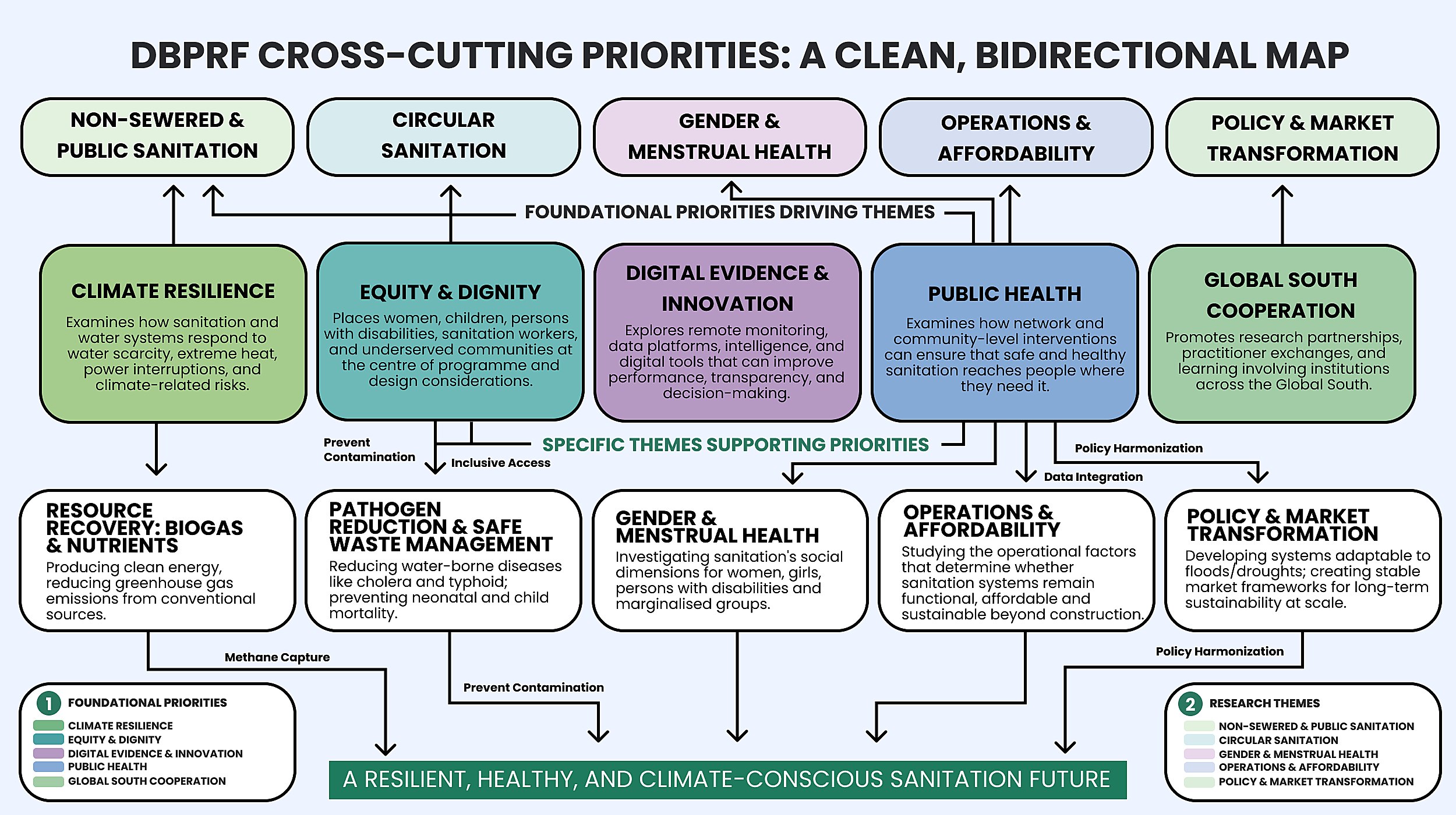 Cross-cutting priorities connecting DBPRF's six research themes
How sanitation and water systems respond to water scarcity, flooding, extreme heat, power interruptions and other climate risks.
Placing women, children, persons with disabilities, sanitation workers and underserved communities at the centre of research and programme design.
Sensors, remote monitoring, data platforms, artificial intelligence and other digital tools that improve performance, transparency and decision-making.
The relationship between sanitation, water, hygiene, disease prevention, nutrition and community wellbeing.
Research partnerships, practitioner exchanges, technology adaptation and shared learning between institutions in Asia, Africa and other regions of the Global South.
DBPRF's published research and field studies. Each output is tagged with the research theme it corresponds to.
A comprehensive needs assessment conducted across seven villages in Darbhanga and Madhubani districts of Bihar, examining WASH, childhood malnutrition, adolescent anaemia, diet diversity and farm and non-farm livelihoods. The study engaged 350+ community participants using qualitative methods including focus group discussions and in-depth interviews.
A national research initiative on Menstrual Hygiene Management led by Sulabh International. Visit the dedicated research portal for findings, resources and publications.
The references and frameworks that inform DBPRF's six research themes. Updated monthly as new evidence emerges.
World Health Organization. (2018). Guidelines on Sanitation and Health. Geneva: WHO. https://www.who.int/publications/i/item/9789241514705
World Health Organization. (2022). Sanitation Safety Planning: Manual for Step-by-Step Risk Management for Safely Managed Sanitation Systems (2nd ed.). Geneva: WHO. https://www.who.int/publications/i/item/9789240042582
World Health Organization. (2024). Sanitation Inspections: User Guide and Inspection Packages. Geneva: WHO. https://www.who.int/publications/i/item/9789240096929
World Bank. (n.d.). Citywide Inclusive Sanitation Initiative. https://www.worldbank.org/en/topic/sanitation/brief/citywide-inclusive-sanitation
International Organization for Standardization. (2025). ISO 30500:2025—Non-Sewered Sanitation Systems: Prefabricated Integrated Treatment Units. Geneva: ISO. https://www.iso.org/standard/30500.html
World Health Organization & UNICEF. (2022). WASH FIT: A Practical Guide for Improving Quality of Care through Water, Sanitation and Hygiene in Health Care Facilities (2nd ed.). Geneva: WHO. https://www.who.int/publications/i/item/9789240045385
Global Sanitation Center of Excellence, IIT Palakkad, & International Water Association. (2026). Second International Conference on Non-Sewered Sanitation Systems—ICNSS 2026. https://icnss.in/
Ministry of Housing and Urban Affairs. (2021). Swachh Bharat Mission–Urban 2.0 Operational Guidelines. New Delhi: MoHUA. https://sbmurban.org/
Central Public Health and Environmental Engineering Organisation. (2018). Advisory on Public and Community Toilets. New Delhi: CPHEEO. https://cpheeo.gov.in/
Central Public Health and Environmental Engineering Organisation. (2020). Advisory on On-Site and Off-Site Sewage Management Practices. New Delhi: CPHEEO. https://cpheeo.gov.in/
Ministry of Urban Development. (2017). National Policy on Faecal Sludge and Septage Management. New Delhi: MoUD. https://mohua.gov.in/
NITI Aayog & National Faecal Sludge and Septage Management Alliance. (2021). Faecal Sludge and Septage Management in Urban Areas: Service and Business Models. New Delhi: NITI Aayog. https://www.niti.gov.in/
Department of Drinking Water and Sanitation. (2020). Operational Guidance on Selection and Construction of Twin-Pit Toilets. New Delhi: DDWS. https://jalshakti-ddws.gov.in/
Devaraj, R., Raman, R. K., Wankhade, K., Narayan, D., Ramaswamy, N., & Malladi, T. (2021). Planning fecal sludge management systems: Challenges observed in a small town in Southern India. Journal of Environmental Management, 281, 111811. https://doi.org/10.1016/j.jenvman.2020.111811
Manga, M., Kolsky, P., Rosenboom, J. W., Ramalingam, S., Sriramajayam, L., Bartram, J., & Stewart, J. (2022). Public health performance of sanitation technologies in Tamil Nadu, India. International Journal of Hygiene and Environmental Health, 243, 113987. https://doi.org/10.1016/j.ijheh.2022.113987
Hussain, F., Clasen, T., Akter, S., & Bawel, V. (2017). Advantages and limitations for users of double-pit pour-flush latrines: A qualitative study in rural Bangladesh. BMC Public Health, 17, 515. https://doi.org/10.1186/s12889-017-4421-z
Jothinathan, H., & Singh, A. P. (2025). Decentralized faecal sludge management in rural India by integrating drying beds for dewatering and coagulation for leachate treatment. Journal of Water Process Engineering. https://doi.org/10.1016/j.jwpe.2025.106123
Jha, P. K. (n.d.). Recycling and reuse of human excreta from public toilets through biogas generation to improve sanitation, community health and environment. Sulabh International Academy of Environmental Sanitation. https://www.sulabhinternational.org/public-toilet-linked-biogas-plant/
United Nations Environment Programme & GRID-Arendal. (2023). Wastewater: Turning Problem to Solution—A Rapid Response Assessment. Nairobi: UNEP. https://www.unep.org/resources/report/wastewater-turning-problem-solution
World Bank. (n.d.). Citywide Inclusive Sanitation Initiative. https://www.worldbank.org/en/topic/sanitation/brief/citywide-inclusive-sanitation
World Health Organization. (n.d.). Guidelines for the Safe Use of Wastewater, Excreta and Greywater. Geneva: WHO. https://www.who.int/publications/i/item/9241546824
World Health Organization. (2022). Sanitation Safety Planning (2nd ed.). Geneva: WHO. https://www.who.int/publications/i/item/9789240042582
International Labour Organization, WaterAid, World Health Organization, & World Bank. (2019). Health, Safety and Dignity of Sanitation Workers: An Initial Assessment. Geneva: ILO. https://www.ilo.org/wcmsp5/groups/public/---ed_dialogue/---sector/documents/publication/wcms_732862.pdf
NITI Aayog & National Faecal Sludge and Septage Management Alliance. (2021). Faecal Sludge and Septage Management in Urban Areas. New Delhi: NITI Aayog. https://www.niti.gov.in/
NITI Aayog. (2023). Reuse of Treated Wastewater in Urban/Peri-Urban Agriculture in India. New Delhi: NITI Aayog. https://www.niti.gov.in/
Ministry of Housing and Urban Affairs. (2025). Advisory on Promoting Offtake of Treated Sewage Sludge Using Solar Greenhouse Dryer. New Delhi: MoHUA. https://mohua.gov.in/
Mehta, M., Mehta, D., & Yadav, U. (2019). Citywide inclusive sanitation through scheduled desludging services: Emerging experience from India. Frontiers in Environmental Science. https://doi.org/10.3389/fenvs.2019.00188
Global Sanitation Center of Excellence, IIT Palakkad, & International Water Association. (2026). ICNSS 2026. https://icnss.in/
Cardone, R., Schrecongost, A., & Gilsdorf, R. (2018). Shared and Public Toilets: Championing Delivery Models That Work. Washington, DC: World Bank. https://www.worldbank.org/en/topic/water/publication/shared-and-public-toilets-championing-delivery-models-that-work
World Bank. (n.d.). Citywide Inclusive Sanitation Initiative. https://www.worldbank.org/en/topic/sanitation/brief/citywide-inclusive-sanitation
World Health Organization. (2018). Guidelines on Sanitation and Health. Geneva: WHO. https://www.who.int/publications/i/item/9789241514705
International Labour Organization, WaterAid, World Health Organization, & World Bank. (2019). Health, Safety and Dignity of Sanitation Workers. Geneva: ILO. https://www.ilo.org/wcmsp5/groups/public/---ed_dialogue/---sector/documents/publication/wcms_732862.pdf
Central Public Health and Environmental Engineering Organisation. (2018). Advisory on Public and Community Toilets. New Delhi: CPHEEO. https://cpheeo.gov.in/
Ministry of Housing and Urban Affairs. (2021). Swachh Bharat Mission–Urban 2.0 Operational Guidelines. https://sbmurban.org/
Ministry of Housing and Urban Affairs. (2024). Clean Toilets Campaign 2024: Campaign Guidelines. New Delhi: MoHUA. https://mohua.gov.in/
Ministry of Housing and Urban Affairs. (2025). Swachh Survekshan 2025–26 Toolkit. https://swachhsurvekshan.org/
Ministry of Housing and Urban Affairs. (2023). Gender Equality and Social Inclusion Guidelines for AMRUT 2.0. https://amrut.gov.in/
Sprouse, L., et al. (2024). Shared sanitation in informal settlements: A systematic review and meta-analysis of prevalence, preferences, and quality. International Journal of Hygiene and Environmental Health, 260, 114392. https://doi.org/10.1016/j.ijheh.2024.114392
Lebu, S., et al. (2024). Indicators for evaluating shared sanitation quality. npj Clean Water, 7. https://doi.org/10.1038/s41545-024-00300-5
O'Reilly, K., & Budds, J. (2023). Sanitation citizenship: State expectations and community practices of shared toilet use and maintenance in urban India. Environment and Urbanization, 35(1). https://doi.org/10.1177/09562478221143936
World Health Organization & UNICEF. (2024). Progress on Drinking Water, Sanitation and Hygiene in Schools 2015–2023: Special Focus on Menstrual Health. https://www.who.int/publications/i/item/9789240096905
World Health Organization & UNICEF. (2025). Essential Services for Quality Care: WASH, Waste and Electricity in Healthcare Facilities. https://www.who.int/publications/i/item/9789240103450
Sulabh International Social Service Organisation. (2024, January 23). Menstruation—taboos, stigma, constraints still persist, reveals study. https://www.sulabhinternational.org/menstruation-taboos-stigma-constraints-still-persist-reveals-study/
Sulabh International Social Service Organisation. (2024, May 28). Sulabh International inaugurates the Menstrual Hygiene Management (MHM) Knowledge Hub. https://www.sulabhinternational.org/news/
Sulabh International Social Service Organisation. (2025, January 27). Sulabh International inaugurates menstrual hygiene facility at Gokhul Phuleswari Degree College. https://www.sulabhinternational.org/sulabh-international-inaugurates-menstrual-hygiene-facility-at-gokhul-phuleswari-degree-college/
World Health Organization. (2026, June 18). Menstrual health [Fact sheet]. https://www.who.int/news-room/fact-sheets/detail/menstrual-health
World Health Organization. (2022, June 22). WHO statement on menstrual health and rights. https://www.who.int/news/item/22-06-2022-who-statement-on-menstrual-health-and-rights
World Health Organization & UNICEF. (2025). Progress on Household Drinking Water, Sanitation and Hygiene 2000–2024: Special Focus on Inequalities. ISBN 978-92-4-011514-9. https://washdata.org/reports/jmp-2025-wash-households
World Health Organization & UNICEF. (2024). Progress on Drinking Water, Sanitation and Hygiene in Schools 2015–2023: Special Focus on Menstrual Health. https://www.who.int/publications/i/item/9789240096905
Ministry of Health and Family Welfare. (2024). Menstrual Hygiene Policy for School-Going Girls. New Delhi: NHM. https://nhm.gov.in/
Ministry of Housing and Urban Affairs. (2023). Gender Equality and Social Inclusion Guidelines for AMRUT 2.0. https://amrut.gov.in/
Supreme Court of India. (2026, January 30). Dr. Jaya Thakur v. Government of India and Others, Writ Petition (Civil) No. 1000 of 2022, 2026 INSC 97. https://main.sci.gov.in/
Head, A., et al. (2024). Systematic review of the effectiveness of menstrual health interventions in low- and middle-income countries in the East Asia and Pacific region. The Lancet Regional Health—Southeast Asia, 20, 100295. https://doi.org/10.1016/j.lansea.2023.100295
Nelson, K. A., et al. (2025). Effects and costs of a multi-component menstrual health intervention—MENISCUS. The Lancet Global Health, 13(5), e888–e899. https://doi.org/10.1016/S2214-109X(25)00007-5
Starr, M., et al. (2025). Epidemiology of menstrual-related absenteeism in 44 low-income and middle-income countries. The Lancet Global Health, 13(2), e285–e297. https://doi.org/10.1016/S2214-109X(24)00468-6
Hennegan, J., et al. (2021). Menstrual health: A definition for policy, practice, and research. Sexual and Reproductive Health Matters, 29(1), 1911618. https://doi.org/10.1080/26410397.2021.1911618
van Eijk, A. M., et al. (2016). Menstrual hygiene management among adolescent girls in India: A systematic review and meta-analysis. BMJ Open, 6, e010290. https://doi.org/10.1136/bmjopen-2015-010290
World Bank. (n.d.). Citywide Inclusive Sanitation Initiative. https://www.worldbank.org/en/topic/sanitation/brief/citywide-inclusive-sanitation
International Labour Organization, WaterAid, World Health Organization, & World Bank. (2019). Health, Safety and Dignity of Sanitation Workers: An Initial Assessment. https://www.ilo.org/wcmsp5/groups/public/---ed_dialogue/---sector/documents/publication/wcms_732862.pdf
Global Sanitation Center of Excellence, IIT Palakkad, & International Water Association. (2026). ICNSS 2026. https://icnss.in/
Sprouse, L., et al. (2024). Shared sanitation in informal settlements: A systematic review and meta-analysis. International Journal of Hygiene and Environmental Health, 260, 114392. https://doi.org/10.1016/j.ijheh.2024.114392
Ministry of Housing and Urban Affairs. (2024). Clean Toilets Campaign 2024: Campaign Guidelines. https://mohua.gov.in/
Ministry of Housing and Urban Affairs. (2025). Swachh Survekshan 2025–26 Toolkit. https://swachhsurvekshan.org/
Ministry of Housing and Urban Affairs. (2021). Swachh Bharat Mission–Urban 2.0 Operational Guidelines. https://sbmurban.org/
NITI Aayog. (2021). Reforms and Action Points to Strengthen the Science, Technology and Innovation Ecosystem in India. New Delhi: NITI Aayog. https://www.niti.gov.in/
NITI Aayog. (2023). Reuse of Treated Wastewater in Urban/Peri-Urban Agriculture in India. https://www.niti.gov.in/
NITI Aayog. (2025). Annual Report 2024–25. New Delhi: NITI Aayog. https://www.niti.gov.in/
Ministry of Housing and Urban Affairs. (2021). AMRUT 2.0 Operational Guidelines. https://amrut.gov.in/
To suggest a resource for inclusion, contact info@dbprf.in
Last updated: August 2026